Background
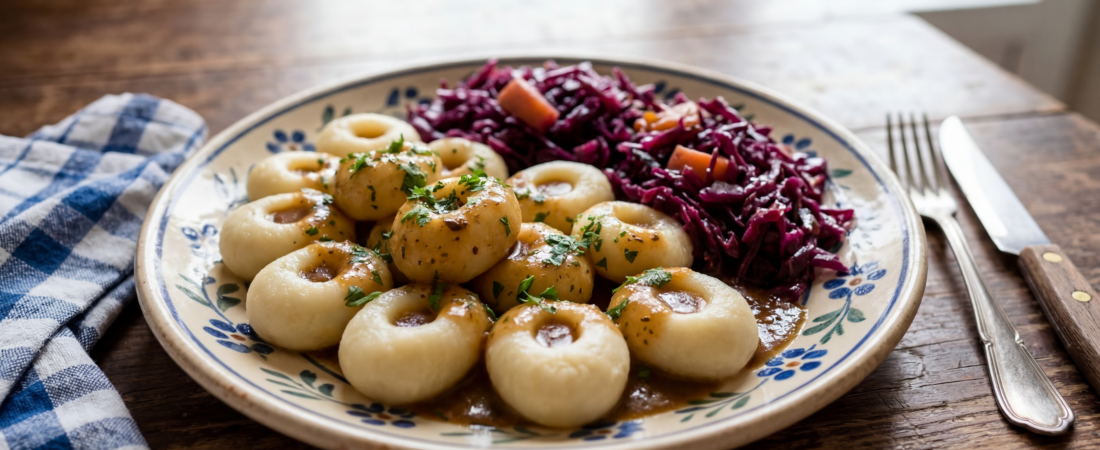
Silesian dumplings or Kluski śląskie in Polish, are a Nationally loved dish. Officially recognised by the Polish Ministry of Agriculture and Rural Development as traditional products of Silesia & Upper Silesia (Southern & South Western) regions of Poland.
Similar to Kopytka, Silesian dumplings have records dating back to the 18th Century. Being accredited primarily as a Peasant food, its believed popularity soared due to it being another recipe that was cheap, easy, filling and helped manage excess amounts of Potatoes before they expired between seasons.
Nowadays, Silesian dumplings are an regarded as the primary side choice when serving Rolada Śląska. A tradition that is strictly upheld in even the most high-end Polish restaurants. However, that’s not to say they should be limited to one dish. As the dumplings go very well with any dish that has generous amounts of sauce such as Gulasz.
Ingredients for Silesian dumplings
| – 1.4kg (3 lbs) of all purpose potatoes – 200g (7 oz) of Potato Starch – 1 Teaspoon of Salt |
Preparation for Silesian dumplings
- Wash and Peel the Potatoes
- Weigh the starch and set aside until mixing
Method
Boil & Mash
After Peeling, I recommend cutting the potatoes into thin slices around 1.5cm (1/2 inch) thick. This will allow them to cook much quicker for mashing. Pre-heat a large pot with salted water and boil the potatoes until they can easily be pierced with a fork.
Once they’re ready, drain the water from the pot and ensure no water remains with them. Once they’ve had time to cool slightly, using a masher or food processor. Mash the potatoes until they are smooth. Try not to let any lumps remain as this will affect the end result.
Mixing
Traditional Technique
Transfer to the mashed potatoes to a large mixing bowl and pat/press them into it tightly like a pie. Once the surface is flat and even, remove one quarter of the Potato from the bowl and replace the space with Potato Starch until its even. re-add the quarter portion of potato that was removed and add 1 Teaspoon of Salt. Then mix with your hands thoroughly until smooth and similar to ply dough. If any stickiness remains add pinches of Starch until its no longer sticky.
Modern Technique
After the Potatoes have been mashed, weigh the the large mixing bowl empty (unless you already know its weight), then weigh the mixing bowl with the Potatoes. Make a note of both weights and subtract the mixing bowl weight from weight of it containing the potatoes.
The ratio by weight is 250g (8.8 oz) of Starch for every 1kg (2.2lbs) of cooked potato. After Peeling, boiling and evaporation my cooked potatoes weighed 1.1kg (2.4lbs). So I’m adding 275g (9.7 oz) of starch to the mixing bowl. Add 1 Teaspoon of Salt before mixing with your hands thoroughly until smooth and similar to ply dough.
Important: Try not to over knead the dough, as this will making the dumplings very dense and less enjoyable. Once its thoroughly mixed and isn’t sticky, you’re good to go!
Shaping
Using your hands, scoop out some of the mixture and roll it into a ball around the size of a walnut. Set it on the counter top and use your thumb to make an indent around halfway deep. This will ensure its fully cooked in the next stage and captures sauce when serving.
If you’re a rather glamorous individual, you can use any utensil that has a thick handle with a rounded end to make the indentations.
Ideally each dumping should be around 4cm (1.5 inch) wide by 2cm (3/4 inch) high. That being said, the most important thing is they are all around the same size so they cook evenly. Continue shaping until all the mixture has been used.
Time To Boil
Using a large pot, fill it half way with water and bring to the boil. When the water is boiling, add around a teaspoon of Salt and reduce the heat slightly until the water surface has calmed to a gentle simmer. Before adding the adding the 1 Tablespoon of oil to the water (this will reduce sticking).
Carefully add a as many dumplings as you can without overcrowding the pot, as they will stick together. If they stick to the bottom when you drop them in, you can very gently stir the water and this should loosen them.
You’ll know they’re close to being cooked once they rise to the surface. After they do, allow them to float and cook for around another 3 minutes before removing them. Continue in batches until all the dumplings have been cooked.
Serving
Silesian dumplings are traditionally served immediately as a side with main dishes that have a generous amount of sauce. However, its common for them to be served as a main dish, topped with fried bacon and onions.
Storing Silesian dumplings
If frozen within an hour of cooking in food safe, airtight freezer bags. Then Silesian dumplings can be frozen up to 4 months. To re-heat, simply add them to boiling water again from frozen and simmer for around 5 minutes or until they float.